Advanced Long-term
Earth System Forecasting

Hao Wu1,2,*,✉, Yuan Gao1,*,✉, Ruijian Gou3,*, Xian Wu2,*, Chuhan Wu2,*, Huahui Yi4,*, Johannes Brandstetter5,6, Fan Xu7,20, Kun Wang8, Penghao Zhao2, Hao Jia2, Qi Song7, Xinliang Liu3, Juncai He1, Shuhao Cao9, Huanshuo Dong7, Yanfei Xiang1, Fan Zhang10, Haixin Wang11, Xingjian Shi12, Qiufeng Wang13, Shuaipeng Li2, Ruobing Xie2, Feng Tao14, Yuxu Lu15, Yu Guo16, Yuntian Chen17, Yuxuan Liang18, Qingsong Wen19, Wanli Ouyang10,20, Deliang Chen1, Xiaomeng Huang1,✉,‡

Tsinghua University • Tencent • Ocean University of China • West China Biomedical Big Data Center • JKU Linz • USTC • NTU • UMKC • CUHK • UCLA • Boson AI • Southeast University • Cornell • PolyU • CityU HK • EIT Ningbo • HKUST (GZ) • Squirrel Ai • Shenzhen Loop Area Institute

* Equal contribution; ✉ Technical Lead; ‡ Corresponding author.
Abstract

Reliable long-term forecast of Earth system dynamics is fundamentally limited by instabilities in current artificial intelligence (AI) models during extended autoregressive simulations. These failures often originate from inherent spectral bias, leading to inadequate representation of critical high-frequency, small-scale processes and subsequent uncontrolled error amplification.

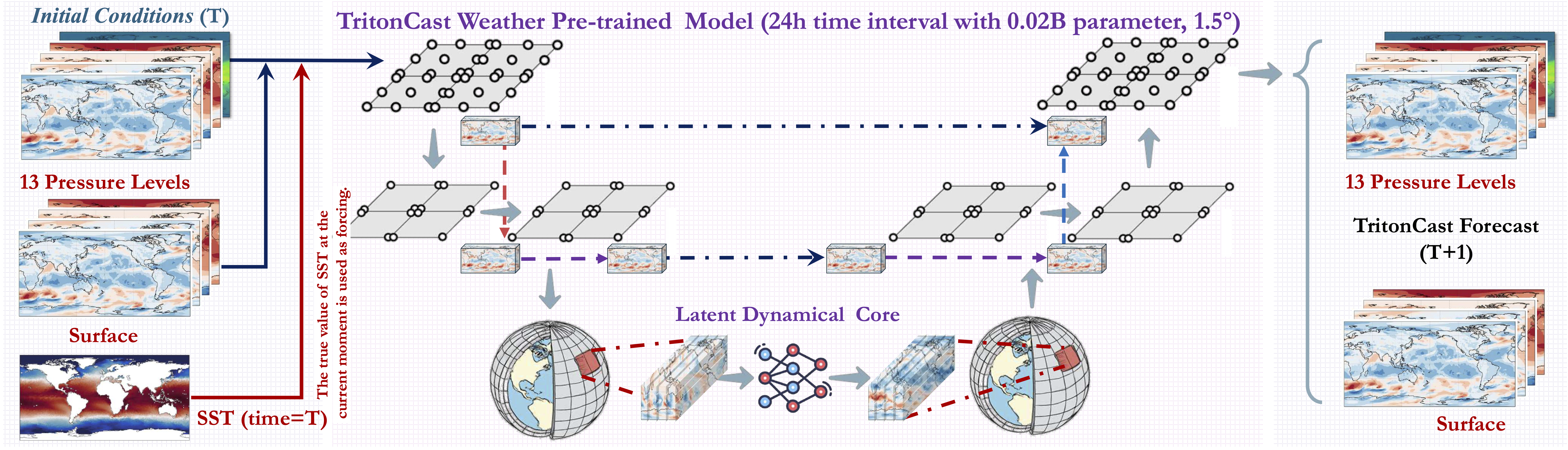
Inspired by the nested grids in numerical models used to resolve small scales, we present TritonCast. At the core of its design is a dedicated latent dynamics core, which ensures the long-term stability of the macro-evolution at a coarse scale. An outer structure then fuses this stable trend with fine-grained local details. This design effectively mitigates the spectral bias caused by cross-scale interactions.

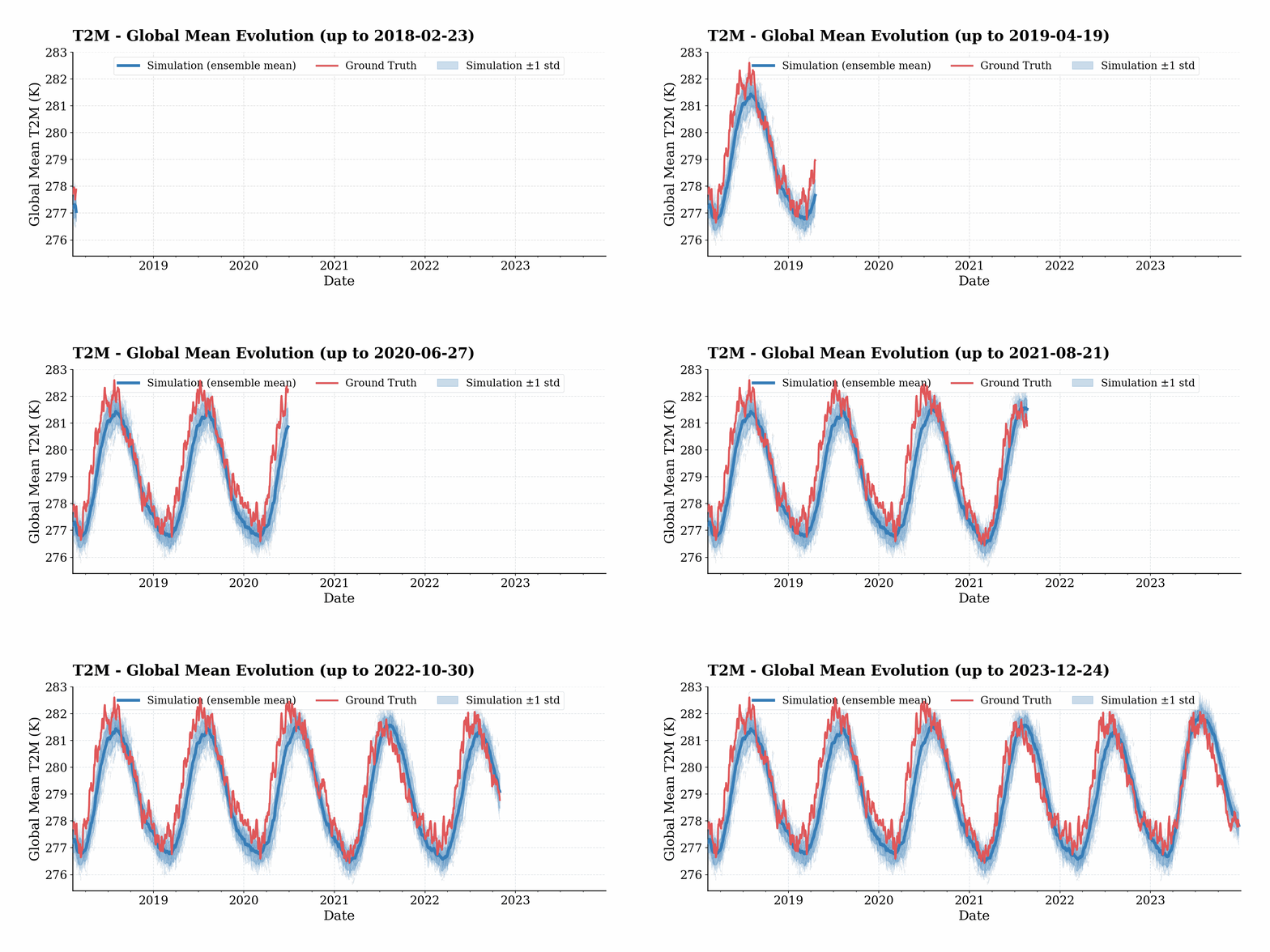
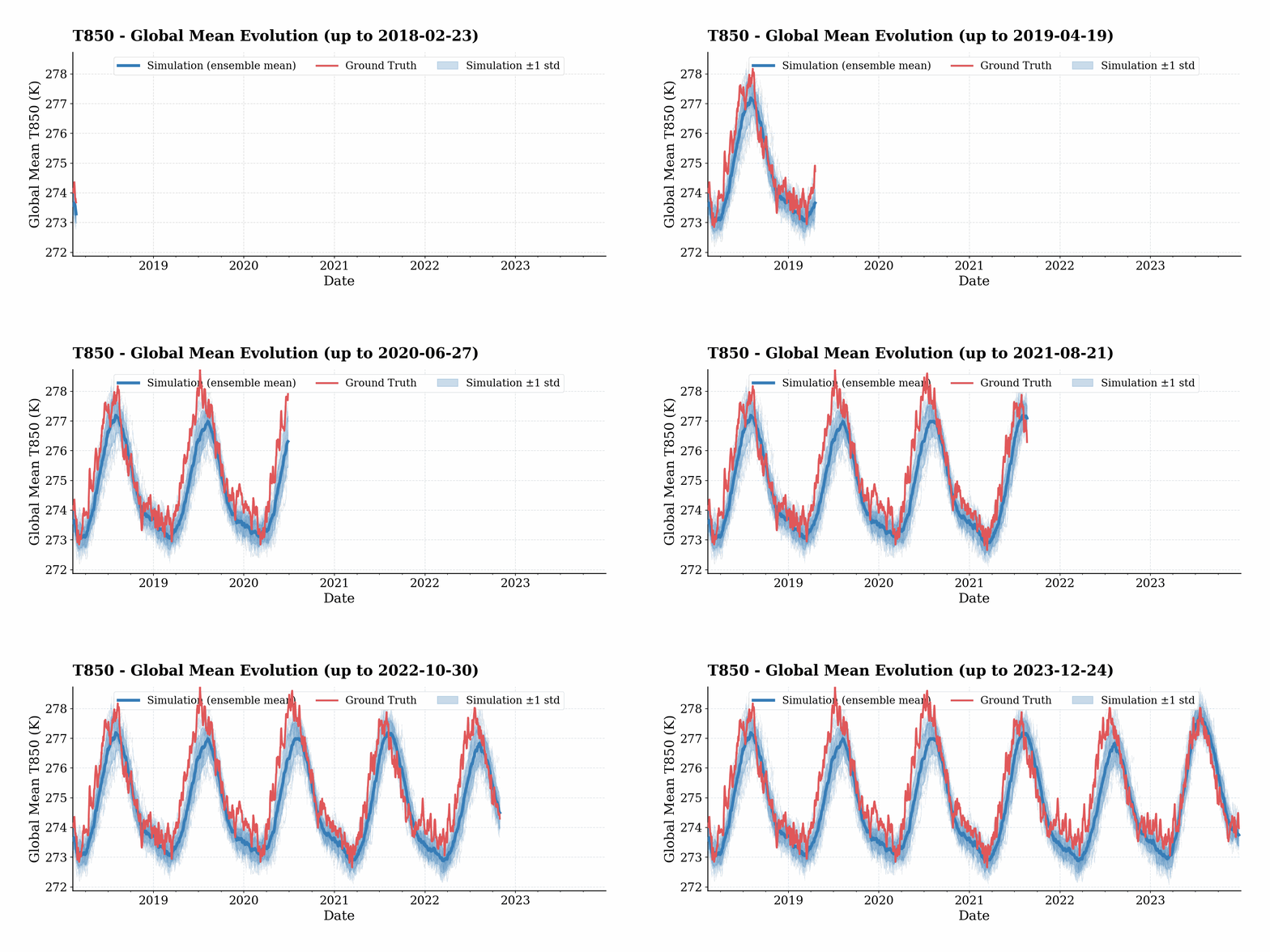
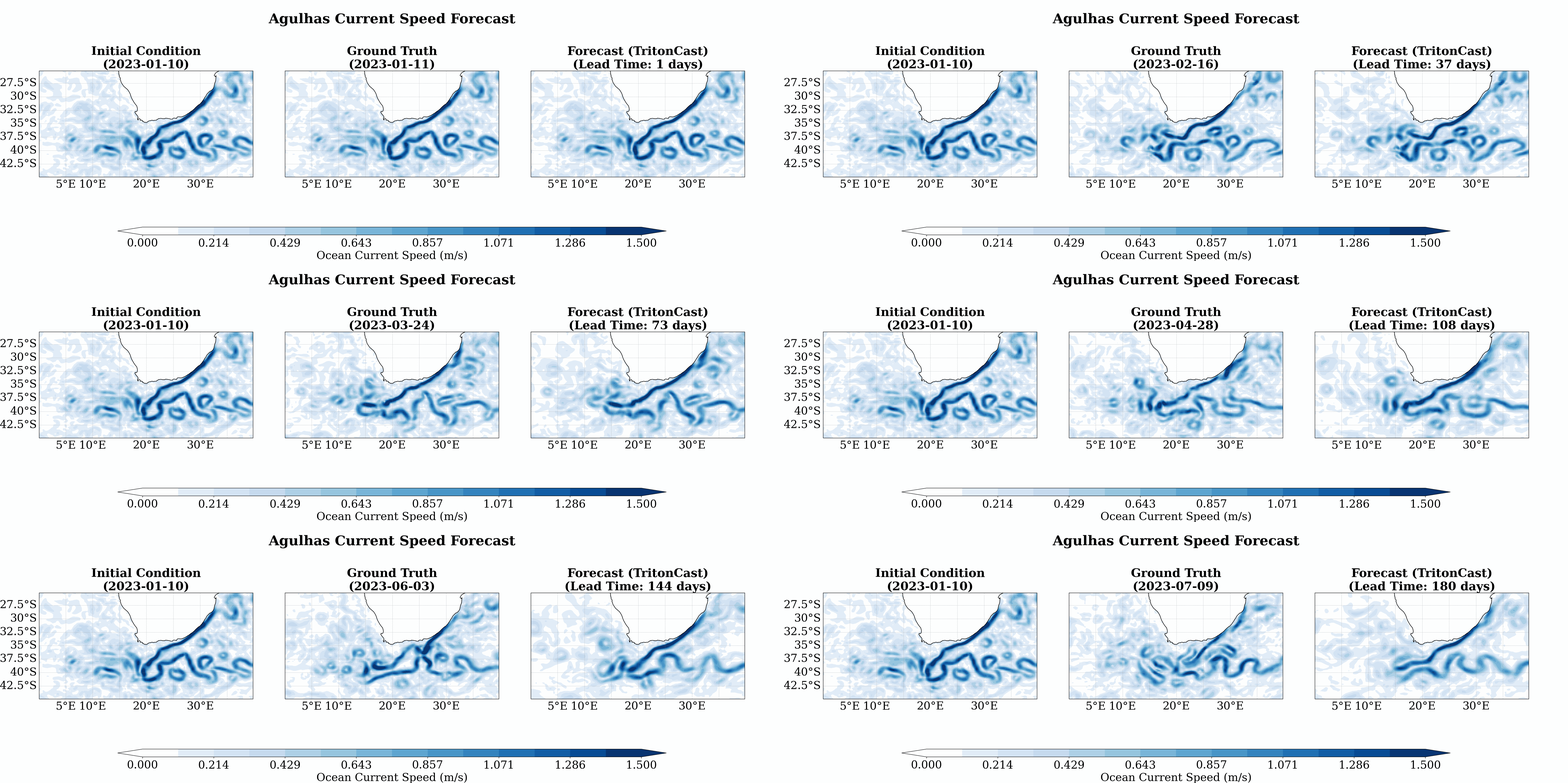
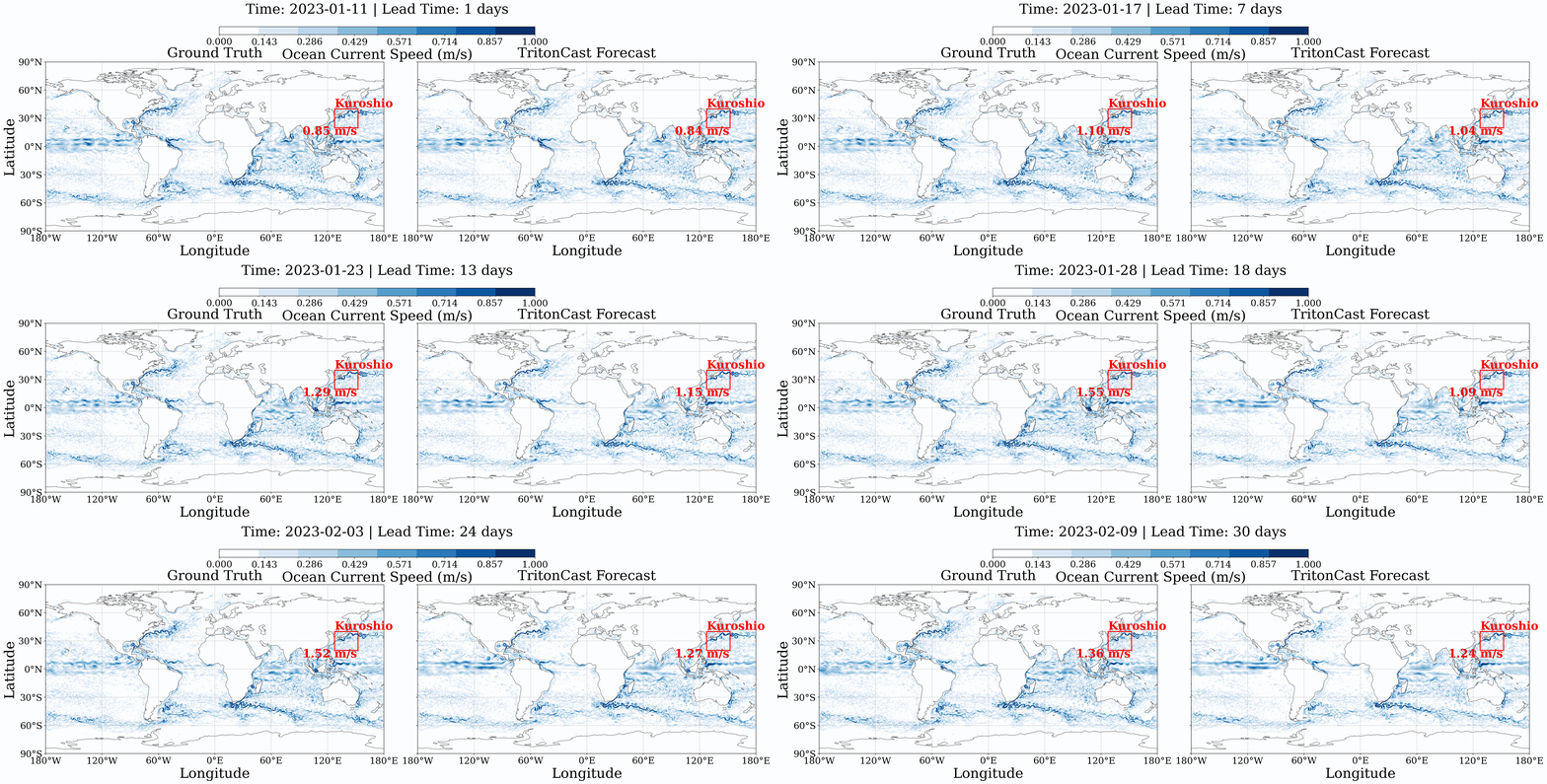
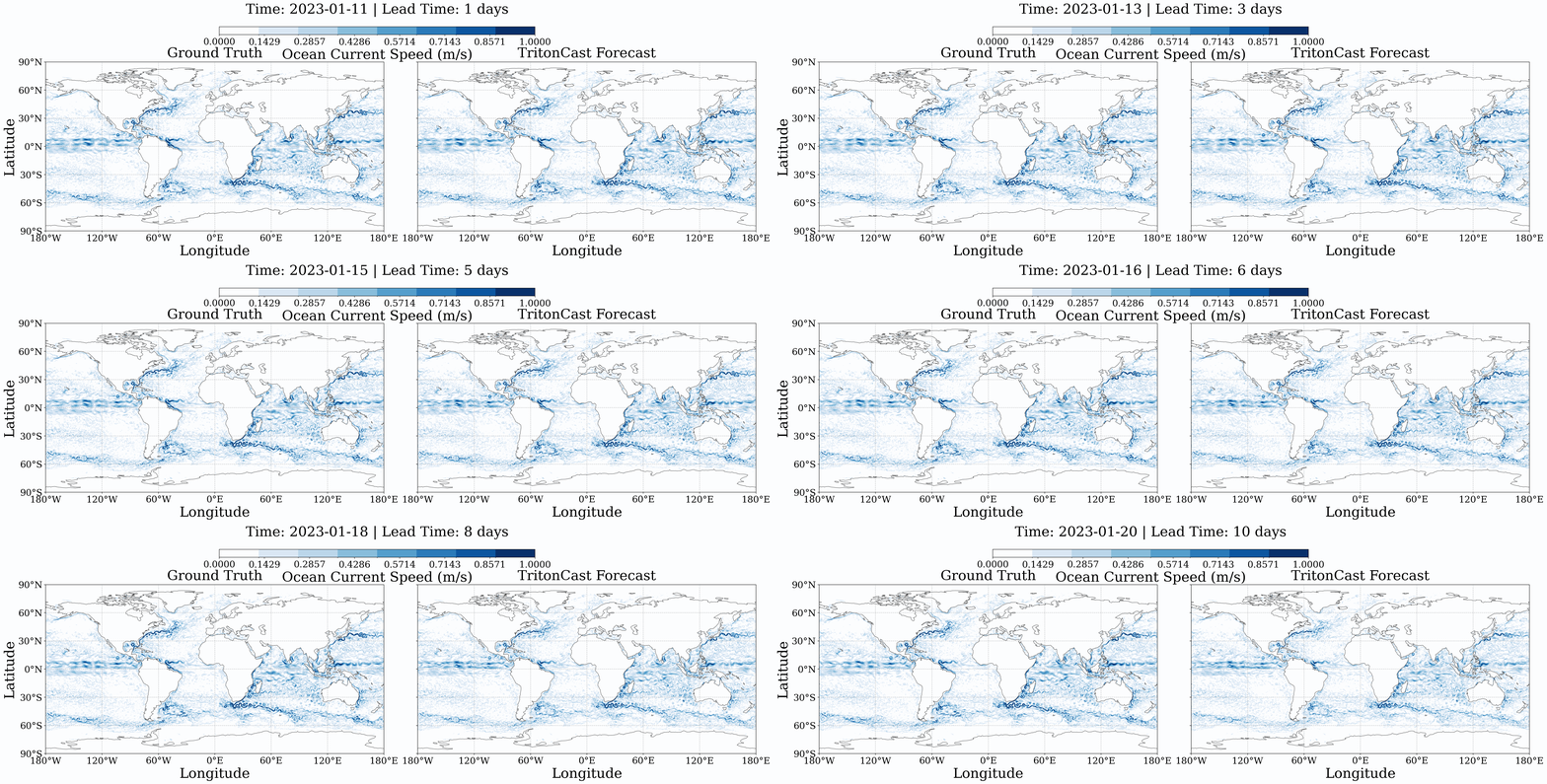
In atmospheric science, it achieves state-of-the-art accuracy on the WeatherBench 2 benchmark while demonstrating exceptional long-term stability: executing year-long autoregressive global forecasts and completing multi-year climate simulations that span the entire available 2500-day test period without drift. In oceanography, it extends skillful eddy forecast to 120 days and exhibits unprecedented zero-shot cross-resolution generalization.

System Architecture

Overview of the V-cycle architecture ensuring multi-scale stability.

Initialize PDF Renderer...

Figure 1: The TritonCast Architecture. (a) The core V-cycle mechanism. (b) Stability demonstration over year-long forecasts. (c-d) Capabilities in capturing ocean eddy dynamics.

Year-long Weather Forecasting

Temperature
Temperature
Global Temperature (1000 hPa)
Wind Dynamics
Wind
Meridional Wind Component
Geopotential
Z500
Geopotential Height (500 hPa)
Multivariate
Combined
Atmospheric Stability Overview

Climate Simulation (AMIP)

Workflow Workflow
Climate Simulation Workflow
T2M Simulation T2M
Z500 Simulation Z500

Evolution Metrics

Global Mean Global Mean T850

Ocean Eddy Dynamics

Agulhas Current

High-Resolution Eddy Shedding

TritonCast successfully captures the complex eddy shedding phenomena in the Agulhas region, maintaining structure over long horizons.

Agulhas
Gulf Stream Gulf Stream
Kuroshio Current Kuroshio

Global Benchmark Performance

Global

Global Speed

Comparison

Speed Comparison

×